Showing posts with label France. Show all posts

Monday, April 25, 2011

Louis Le Nain - Adoration of the Shepherds

Louis le Nain (1593-1648) - Adoration of the Shepherds (circa 1640)
Great Britain Stamp issued 1967
Held at the UK National Gallery 

 Louis le Nain was one of three brothers who were famous for depicting common scenes from peasant life, during a time when many artists were painting scenes of excessive richness and plentitude in other parts of Europe.  This religious scene made it to a Christmas stamp in the UK in 1967.

Sunday, April 24, 2011

The Annunciation - Artist Unknown (Savoy School France)

Unknown Artist from the Savoy School (1480) - "The Annunciation"
France Stamp issued 1970 - 1 Franc

This stamp depicts a favourite scene from renaissance artists, being the annuniciation, or otherwise known as the time when the angel Gabriel came on down to earth to let Mary know that she was going to have a little baby Jesus.  

Friday, June 4, 2010

Jean Baptiste Simeon Chardin - Saying Grace

Jean-Baptiste-Simeon Chardin (1699-1779) - Saying Grace. (1740). 
Russia Stamp Issued 1974
Louvre, Paris, France.


Chardin was considered to be a master of still life.  He depicted subjects in everyday life and modest means, while also bringing out amazingly light coloured details against dark backgrounds.  His figures were powerful, yet quite anonymous - it was rare for everyday characters of French life to be depicted in paintings at this time.

Chardin was popular during his time, eventually earning a state pension - however his personal life was marred by sadness with the death of his first wife and daughter in the 1740s, shortly after this painting was completed.


Monday, May 24, 2010

Alberto Magnelli - Virginia

Alberto Magnelli (1888-1971) - Virginia (1914)
France Stamp Issued 1986
Musee Municipal Vallauris

Magnelli was an Italian artist who gained some fame in the early 20th century as an artist, despite lacking a formal art education.  When in Paris, he met Picasso and adopted a cubist style of painting around the time when this painting, Virginia, was completed.   He later went onto paint in a futurist style.


Saturday, May 22, 2010

Marc Chagall - Fiances of the Eiffel Tower

Marc Chagall (1887-1985) - Fiances of the Eiffel Tower (1939)
France Stamp Issued 1963


France has issued a large number of art based stamps, and this is one of the earliest releases for a modern 20th Century artist.  


Russian-French Artist Marc Chagall has been described by Robert Hughes as the quintessential Jewish artist of the 20th Century and the last surviving pioneer of the modernist movement.   


This painting is one of Chagall's dream like works, with an almost surreal quality.  The artists lived a long life, creating a prolific variety of work.  


Sunday, May 16, 2010

Albert Gleizes - Ecuyere

Albert Gleizes (1881-1953) - Ecuyere (1923)
France Stamp Issued 1981
National Museum of Modern Art - Paris

This is an example of one work of cubism that was skillfully mastered by Gleizes.  Objects are broken up and reassembled to provide multiple viewpoints in an abstract form.  An ecuyere is a horseman or knight.

The artist was born and raised in Paris and he served in the French army intermittently up to the beginning of the first world war.   In 1915 he continued his artistic career by moving to New York City, where mush of his work now remains, after having being purchased as part of the Guggenheim Collection.   

Friday, May 14, 2010

Sergi Poliakoff - Composition 1954

Sergi Polliakoff (1900-1969) - Composition 1954
France Stamp Issued 1988
Lille - Musee des Beaux Arts

Born in Russia, this artist began his career as a figurative artist before turning to abstract art when he lived in France in the 1930s and 1940s.  This work is typical of his abstract work, with relatively bright ochre colours in irregular shapes.

The artist became a French citizen in 1962.

Tuesday, May 11, 2010

Jacques Louis David - Napoleon Crossing the Alps

Jacques Louis David (1748-1825) - Napoleon Crossing the Alps (1801)
France Stamp Issued 2008
Held at Chateau de Malmaison

David was an influential painter during his lifetime, as he depicted many paintings of contemporary events.  He lived at an interesting and formative time in French history, so his work was intertwined with the politics of France's influential leaders at the time.  David was devoted to Napoleon, even after the emperor's defeat.

Five versions of this painting was made by David, who was very influential in political circles with Napoleon.  Napoleon crossed the Alps in 1800 and David depicted this event, along with several other crucial events that occurred at the time of the French Revolution.  He also painted coronation celebrations of the Empire, before heading into exile in Belgium during the Restoration under Louis XVII.  David lived in a house that contained many paintings of Napoleon during his exploits, in Rue Fosse-aux Loups in Brussels.

Sunday, May 9, 2010

Johannes Vermeer - Girl with a Pearl Earring

Johannes Vermeer (1632-1675) - Girl with a Pearl Earring (1665)
France Stamp Issued 2008
 Royal Picture Gallery Mauritshuis, The Hague.

Vermeer used expensive pigments in his portraits, including ultramarine - these contribute to a powerful combination of light and depth to his paintings.   He was a successful genre painter of his time, but he produced very few paintings - he specialised in painting exquisite interior scenes depicting middle class Dutch life.  Unfortunately for his family, he left a relatively large debt upon his untimely death in his early 40s.   

Vermeer was not particularly famous until the late 19th century, and his reputation has grown since then.  Only 35 paintings can be reliably attributed to him today.  

This painting was also the subject of a fictional 2003 film and novel by Tracey Chavelier, that tells the story of a fictional account of an affair between the model and the painter from this painting.

Friday, May 7, 2010

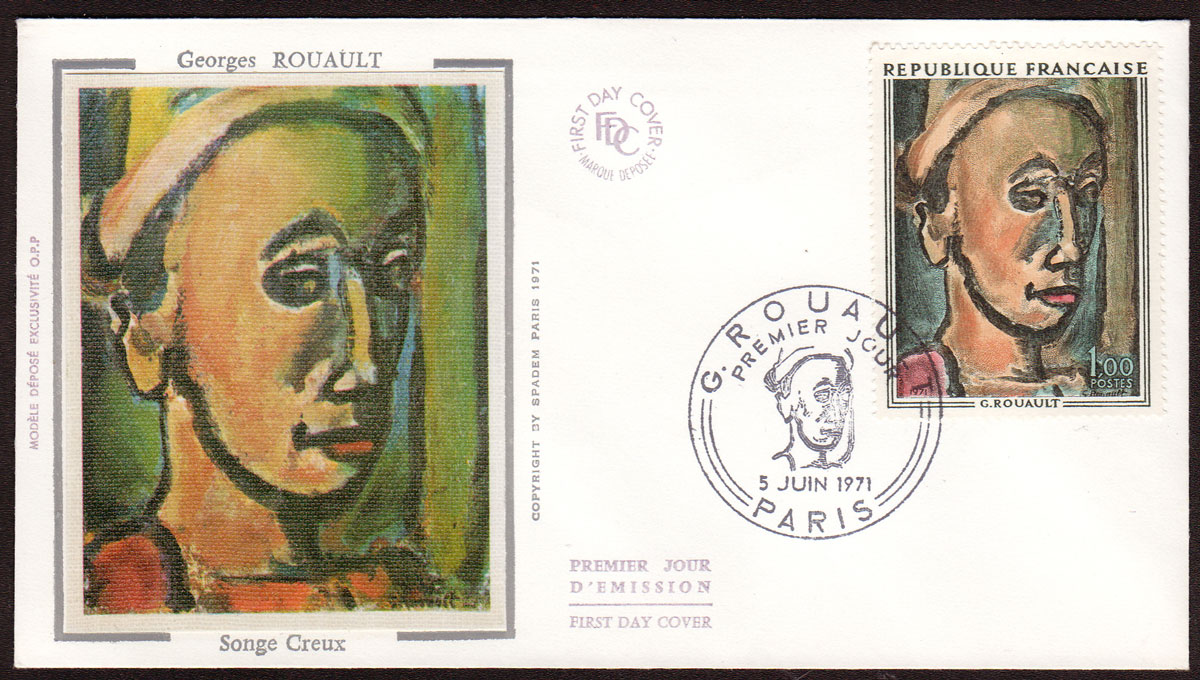
Georges Rouault - The Dreamer

Georges Rouault (1871-1958) 'The Dreamer' (1946)
France Stamp issued 1971
Held at Centre Georges Pompidou. Paris. France


Rouault took up an apprenticeship as a glassmaker in his late teens - the similarity of many of his works to stained glass windows is often accredited to be due to this influence in his learly life.  He was instrumental in the Fauvism Movement. 


Fauvism, generally considered the first artistic revolution of the 20th Century, can be seen as a manifestation of the main impulses of the century: towards autonomy of colour and the intervention of the painter's emotions as a constituent part of the painting.  
- Extract from Chambers Arts Library - Modern Art by Edina Berdand


The fauves were one of the first movements in modern art, but they were less revolutionary than other movements, such as cubism and abstractionism.  Their work is mainly interested in colour, with less distortion of shapes - this is directly seen in the work depicted on this stamp.  

Rouault's work was exhibited in Australia in the 1950s, during an exhibition of modern French artists who were living at the time.  This exhibition was reviewed by the Sydney Morning Herald at the time, and it makes for interesting reading:  French Exhibition is Study in Modern Art (Links to Trove National Library of Australia Newspaper Archives).


Tuesday, May 4, 2010

Quentin Metsys - The Moneylender and his Wife

Quentin Metsys (1466-1530) - The Moneylender and His Wife (1516)
France Stamp issue 2008 
The Louvre, Paris


The majority of Metsys' work depicts the life of merchants in Holland during a prosperous time in their history - this painting was completed when the artist lived in Antwerp at a time when the city was a trading hub for the Spanish and Portuguese.  The people in his paintings are usually depicted in indoor scenes, where there are clear indications of wealth - however, the paintings do not openly show extravagant wealth, as was usual for this time in Holland.  Religious overtones, include the scales of justice behind the subjects, providing insight into the ultimate judgement that each person must face.  The mirror and book on the table are completed to a high level of realistic detail.

Sunday, May 2, 2010

Leonardo da Vinci - Mona Lisa (La Gioconda)

Leonardo da Vinci - Mona Lisa (1506)
France Stamp Issued 2008
Painting held at the Louvre Paris
Today is the 491st anniversary of Leonardo da Vinci's death.  This painting needs no introduction as it is one of the greatest works from the renaissance period.  

Some interesting observations/claims from Wikipedia:
  • the painting was not named until 31 years after Leonardo da Vinci's death
  • it only became very famous from the 18th Century
  • the painting was commissioned for a rich Florentine merchant's family to celebrate the birth of their first child;
  • six million people now view the painting, which is held behind bullet proof glass in a specifically built facility within the Louvre;
  • it was one of the first portrait pictures to depict the sitter in an imaginary landscape and an aerial perspective;
  • it was stolen from the Louvre in 1911 by and Italian employee, who tried to sell the painting to Uffizi Gallery in Florence, after holding it in his apartment for two years.
Leonardo da Vinci also influenced a number of artists of the renaissance period who have had their works depicted on stamps:

Friday, April 30, 2010

Le Lorrain - Sea Port at Sunset

Claude le Lorrain (1605-1682) - Sea Port at Sunset (1635)
France Stamp issued 2008
Louvre Museum, Paris

Claude was born in Lorraine, which was a separate province to France at the time.  He lived a life of poverty in early years, but he eventually went on to work for cardinals and then Pope Urban VIII in Rome in the late 1620s.  He died a wealthy man.

He is most famous for his landscape work, most of which are now held in England.  At the time, landscapes were not considered worthy of being depicted in paintings.  Figures were usually in all of his paintings, but they were small and usually painted by other artists.  An interesting article from the Sydney Morning Herald in 1929 outlines some of the key features of Charles Lorrain's life.

Thursday, April 29, 2010

Charles Le Brun - Femme A Genoux


Charles Le Brun (1619-1690) - Femme A Genoux or Nude Woman Kneeling (c. 1650)
First Day Cover - France Stamp issued 1973
Drawing held at the Louvre Museum Paris


This drawing was meant to be part of a larger work, where a young girl sinner was being struck down by a bolt of lightning by Jesus Christ.  

Charles Le Brun was one of the dominant forces of French Art in the 17th century.  He worked with royalty in parts of Europe and took joint control of the Academy of Painting and Sculpture in Paris in the mid 1600s.  Industrial arts grew immensely at this time, and Le Brun was one of the leading influences on the Loius XIV style of furnishing that was developed during this time.

Towards the latter years of his life, he was an academic and he completed a series of famous paintings depicting Alexander the Great.


Tuesday, April 27, 2010

Edgar Degas - Dancer with Bouquet

Edgar Degas (1834-1917) - Dancer with bouquet
France Stamp Issued 1970
Musee d'Orsay, Paris, France


Degas is regarded as one of the founders of the impressionist movement although he rejected the term, and preferred to refer to his work as realism. He was born into a relatively wealthy family in Paris, and he failed as a law student before embarking on an artistic career.  Degas travelled in Europe in addition to spending time in the United States in the 1870s as he had family there.


Towards the latter half of his career, he was quite successful as he was one of the key painters and organisers of the impressionist movement - however, his works are more known for their emphasis in depicting the beauty of movement of the human form.  As such, ballet is a common subject of Degas' work, consisting of up to a third of all his paintings.  This was quite a contemporary subject at Degas' time, as ballet was a common form of urban entertainment in France at the time when the impressionist movement took place.

Monday, April 26, 2010

Giotto - Sermon of the Birds

Fragment of Sermon of the Birds c. 1302 - Giotto di Bondone (1267-1337) 
France Stamp Issued 2008
Louvre, Paris

Giotto is now regarded as one of the key artists whose work signaled the end of Medieval Gothic and Byzantine Arts towards the early Renaissance.  This is one of his most important works - one of a series of paintings depicting the life of St Francis of Assisi - these frescos are also subject to some dispute as to whether they can be attributed to Giotto.

 Extract from "Renaissance Art" - Chambers Library:

"This is a famous fragment of the predella of a signed picture, which the artist executed for the Franciscans in Pisa.  The aura of spontaneous intimacy - with the saint portrayed in the presence of birds which are not depicted in the manner of medieval art but are individuated- authenticates this panel."


Friday, April 23, 2010

Botticelli - The Birth of Venus

Botticelli - The Birth of Venus (1482)
France Stamp issued 2008
Painting held at Uffizi Museum, Florence Italy

This painting shows the goddess of beauty, Venus, coming to life after Zephyr has breathed life upon her.  Although the painting is clear and full of realism, it is also unrealistic, with an idealized coastline and Venus is unbalanced, with the wind blowing her in towards the coastline. 

Botticelli prodcued a large number of mythological and secular works, although he is also known for depictions of the Madonna.  This work was produced for the Medici family - he later went on to paint the family in his depiction of Adoration of the Magi.


Wednesday, April 21, 2010

Archimboldo - Summer

Archimboldo (1529-1593) - Summer (1573)
France Stamp Issued 2008
The Louvre  - Paris, France

This painting was completed in a style that is classically famous for this painter, as a portrait has completed from fruits and vegetables.  

Although his paintings have a lot of contemporary appeal, they are also interesting from a historical perspective, because they chronicle the arrival of new species of fruits and vegetables in Italy at the time of the Rennaissance.  This painting includes an ear of corn, which would have been imported from the Americas, in addition to brown eggplant from Asia.


Tuesday, April 20, 2010

Raphael - La Belle Jardiniere

Raphael.  The Virgin and Child with Infant John the Baptist in a Landscape
"La Belle Jardiniere". (1507 or 1508)
France Stamp Issued 2008
Oil on panel. Louvre, Paris, France

This painting was completed by the artist when he lived in Florence.  It is one of his classics, with a pyramid style composition, and the depiction of the virgin with classic female beauty.  The infants are cherub like, the entire composition fitting perfectly into the surrounding landscape.

This painting was one of nine that were depicted in French stamps in 2008.

Thursday, April 8, 2010

Australian Animal Sketches - Charles-Alexandre Lesueur & Ferdinand Bauer

Port Lincoln Parrot by Ferdinand Bauer & Kangaroo by Charles-Alexandre Lesueur 
Australian Stamps issued on 4 April 2002 - Joint issue with France
Flinders-Baudin Bicentenary

On the 8th April 1802, the French Explorer Baudin and the English Explorer Flinders crossed paths at Encounter Bay, off the coast of South Australia.  The two nations were great rivals as they both tried to map and document scientific discoveries throughout the region during the French Revolution and Napoleonic Wars of 1792-1815.

The artistic sketches of the animals discovered on the Australian continent are depicted on the stamps - the original sketches are held at the Natural History Museums in London and Paris respectively.